Understand
Learn how rhythm, notation, harmony, and musical form work together.

Private one-on-one instruction gives every child the structure, encouragement, and individual attention needed to read, understand, and truly enjoy music.
Nina helps students connect what they see, hear, sing, feel, and play. This creates musicians who can approach new music independently rather than relying only on imitation or memory.
Lessons are adapted to the student’s age, personality, ability, and pace while maintaining the discipline required for lasting progress.
Learn how rhythm, notation, harmony, and musical form work together.
Develop efficient habits that turn home practice into steady improvement.
Build the focus, poise, expression, and preparation needed to share music.
The curriculum combines the physical, intellectual, and expressive sides of piano study in one connected program.
Fluent score reading through ABC note names, Do-Re-Mi solfege, and regular sight-reading.
LiteracyPitch, intervals, melody, rhythm, memory, and listening skills that deepen understanding.
ListeningHealthy posture, coordination, touch, scales, articulation, and efficient movement.
FoundationScales, chords, symbols, harmony, form, and the structure behind the music.
UnderstandingCarefully selected classical works that support growth, expression, and musical taste.
ArtistryPreparation, concentration, stage confidence, musical communication, and poise.
Confidence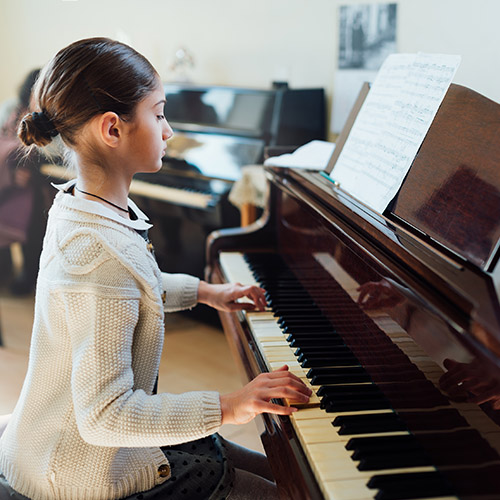
Attention, coordination, rhythm, keyboard geography, listening, and first reading skills.
Technique, fluency, theory, repertoire, ear training, and increasingly independent practice.
Interpretation, confident performance, problem-solving, and the ability to learn unfamiliar music.
Helpful information for families considering private piano instruction.
Children develop at different rates. Nina evaluates readiness individually, considering attention span, interest, coordination and the family’s ability to support regular practice.
Yes. Beginners receive a structured foundation in posture, rhythm, listening, keyboard geography, music reading and healthy piano technique.
Yes. Music reading is central to the academy program. Students learn both ABC note names and the Do-Re-Mi solfege system so they can understand and perform new music independently.
Lessons are private and one-on-one, allowing the pace, repertoire and technical work to be adapted to each student.
Regular access to a properly functioning acoustic piano or a full-size weighted digital keyboard is strongly recommended for meaningful progress between lessons.
The academy is located in Buffalo, New York, and welcomes families from Buffalo, Amherst and surrounding Western New York communities.
Ask About LessonsBecause every student’s needs and schedule are different, tuition and lesson details are discussed personally with parents before enrollment.